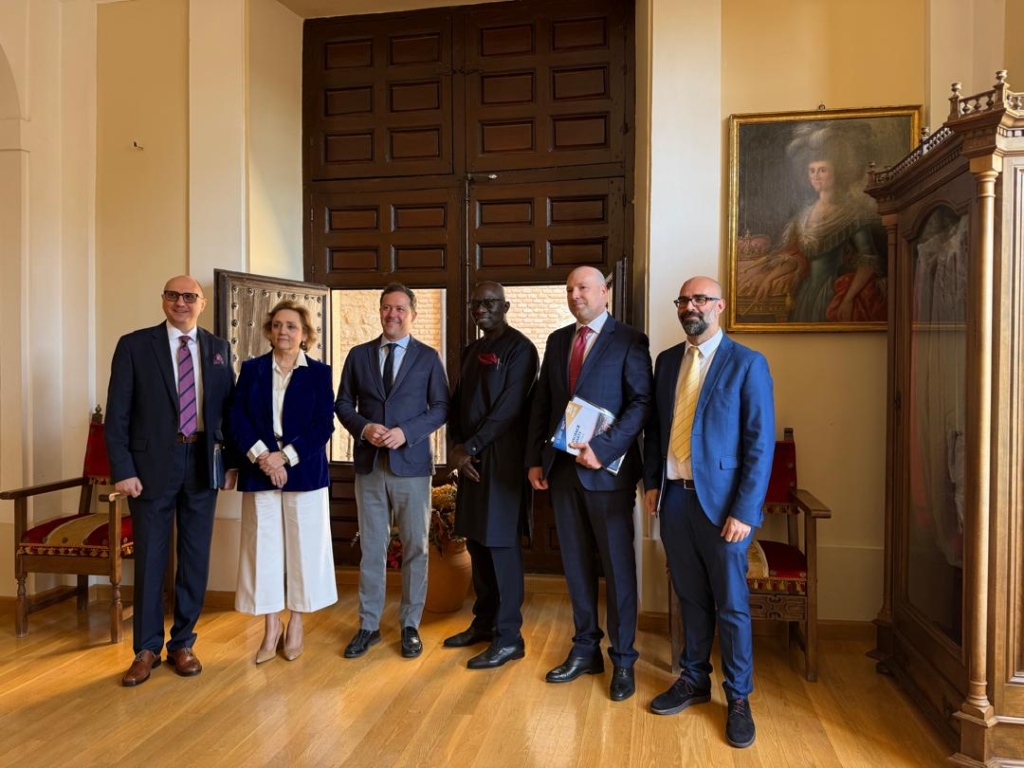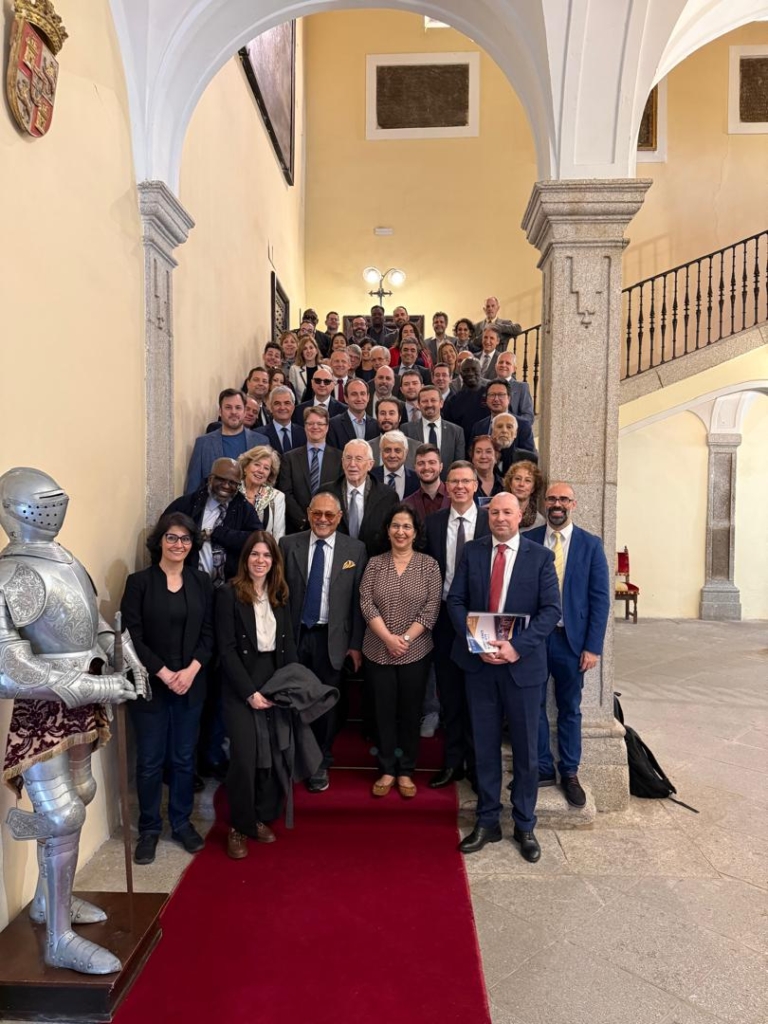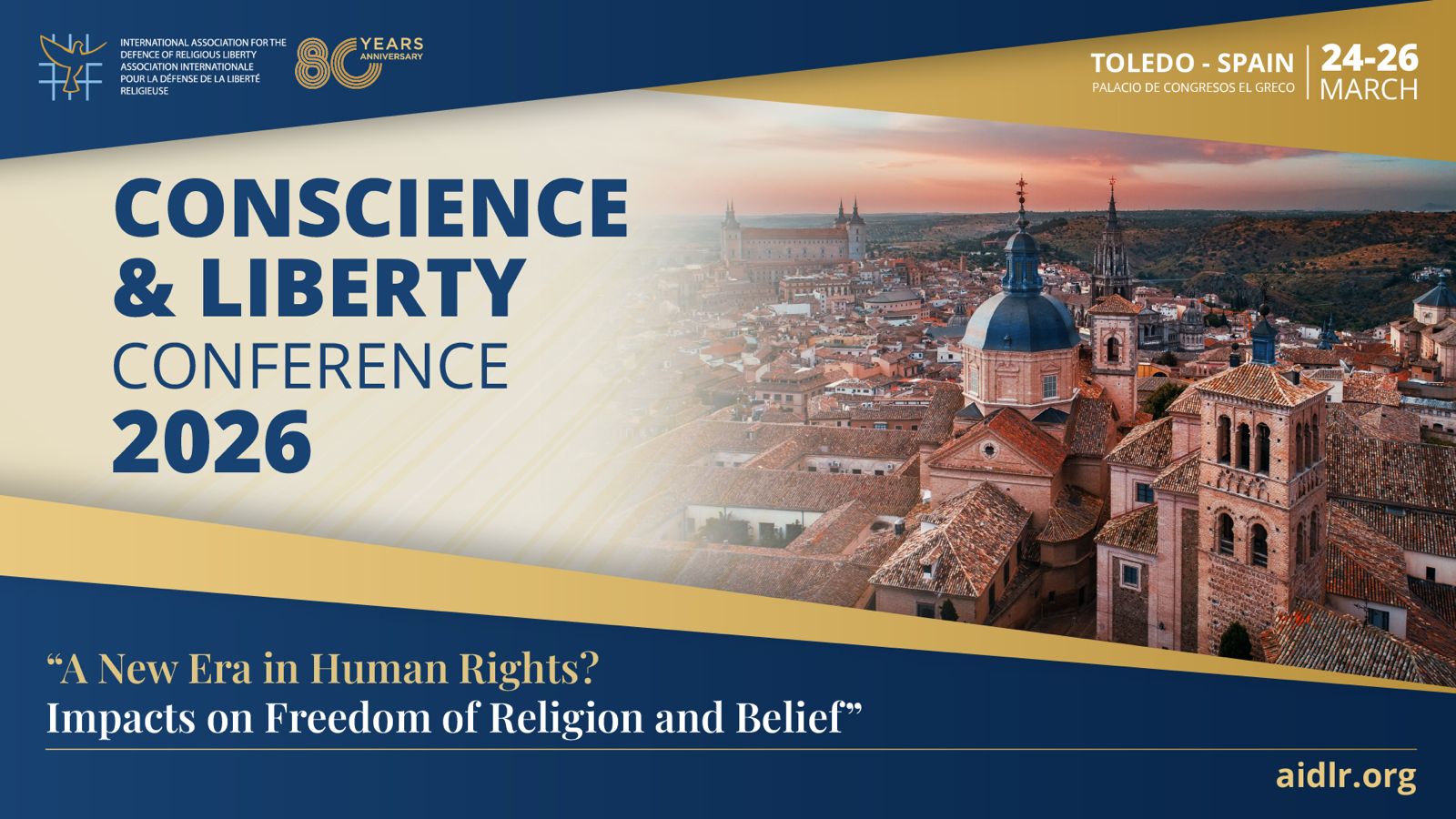
Against the historic backdrop of one of Europe’s most celebrated cities of interreligious coexistence, the International Association for the Defence of Religious Liberty (AIDLR) convenes its Conscience & Liberty 2026 Conference in Toledo, Spain, from 24 to 26 March 2026. The conference, titled “A New Era in Human Rights? Impacts on Freedom of Religion and Belief,” brings together around 70 invited participants from across the globe — scholars, jurists, human rights practitioners, diplomats, faith-based leaders, and representatives of international institutions — for three days of in-depth reflection, debate, and action on the state of freedom of religion or belief (FoRB) in an increasingly turbulent world.
The gathering carried special significance: 2026 marks the 80th anniversary of AIDLR’s founding, making this conference not only a major intellectual and policy event, but a milestone celebration of eight decades of tireless advocacy for the freedom of conscience, religion, and belief.
A City Chosen for Its Symbolism
The choice of Toledo is no accident. Known for centuries as a place where Christian, Jewish, and Muslim communities lived and worked side by side — leaving behind a shared architectural, intellectual, and cultural heritage — Toledo has long embodied the potential of peaceful coexistence across religious difference. It was in this spirit that AIDLR chose the city to host its most ambitious conference since Lisbon in 2023, anchoring the conversations about today’s most pressing threats to religious liberty in a place that still bears witness to what pluralism can achieve.
Opening Ceremony: A Historic Hall, a Global Message
The conference opened on the morning of Tuesday, 24 March 2026, in the Sala Capitular of the Ayuntamiento de Toledo — Toledo’s historic City Hall — in a ceremony that set the tone for the days ahead. The Opening Ceremony was moderated by Paulo Macedo, Secretary General of AIDLR, and Rubén Guzmán of AIDLR Spain.
The proceedings began with an institutional message of the highest international standing: a written address from His Excellency António Guterres, Secretary-General of the United Nations, sent expressly to the conference and read aloud by Dr. Nazila Ghanea, United Nations Special Rapporteur on Freedom of Religion or Belief. In his message, Secretary-General Guterres described freedom of thought, conscience, religion and belief as a cornerstone of human dignity and a litmus test for the state of human rights more broadly. He drew attention to mounting pressures on this fundamental freedom — from the manipulation of belief to incite hostility, to the targeting of religious groups in the name of identity or security, to the deployment of digital surveillance and artificial intelligence without adequate human rights safeguards. The Secretary-General called for a renewed commitment to multilateralism, international law, and dialogue across differences, extending his warmest wishes to all participants and to AIDLR on the occasion of its 80th anniversary.
Institutional addresses followed from a distinguished roster of leaders: Dr. Barna Magyarosi, President of AIDLR; Dr. Adama Dieng, President of the AIDLR Honorary Committee; Dr. Óscar López, President of AIDLR Spain; Dr. Soledad de Frutos del Valle, the representative of the Diputación Provincial de Toledo; and Dr. Carlos Velázquez Romo, Mayor of Toledo, who welcomed the assembly to his city with words underscoring Toledo’s unique vocation as a symbol of intercultural dialogue.
A central moment of the ceremony was the reading of the AIDLR 80th Anniversary Statement, delivered in three languages: in Spanish by Rosa María de Codes, Vice-President of IRLA; in English by Reinhard Schwab of AIDLR Austria; and in French by Francesca Evangelisti of AIDLR Italy. The statement reaffirmed AIDLR’s founding principles and its commitment to defending freedom of conscience as a foundation of world peace.
Eight Decades of History: The Commemorative Video Documentary
The Opening Ceremony also featured the world premiere of a commemorative video documentary marking AIDLR’s 80 years of history. The film traced the association’s journey from its founding by Dr. Jean Nussbaum in 1946 — in the immediate aftermath of the Second World War and amid the drafting of the Universal Declaration of Human Rights — through decades of engagement at the United Nations, the European Union, the Council of Europe, and beyond. Evoking key moments, defining voices, and the steady thread of principle that has guided the organization across generations, the documentary was received with visible emotion by many in the hall.
Nussbaum’s founding motto — “We do not stand for interests. We stand for principles” — resounded throughout the ceremony and indeed across the entire conference as a living charge to all present.
Awards of Honor: Recognizing Lifetimes of Service
In recognition of exceptional contributions to the cause of religious liberty, AIDLR presented its 80th Anniversary Awards of Honor to three distinguished individuals whose careers have been closely intertwined with the work of the association and the broader field of human rights:
-
- Alberto de la Hera, a leading Spanish scholar of ecclesiastical law and church-state relations, whose academic and institutional contributions to the field have spanned decades.
-
- Ganoune Diop, the former Secretary General of the International Religious Liberty Association and former Director of Public Affairs and Religious Liberty of the General Conference of Seventh-day Adventists, and a key figure in international advocacy for FoRB and inter-religious dialogue.
-
- John Graz, former Secretary General of the International Religious Liberty Association (IRLA) and founder of the International Center for Public Affairs and Religious Liberty, in France, whose editorial and diplomatic work has helped shape the global conversation on religious freedom.
The awards were presented in a ceremony that drew sustained applause from the assembled delegates, reflecting the deep esteem in which all three honorees are held across this religious liberty community and beyond.
Plenary Sessions: Engaging the Critical Questions
Following the Opening Ceremony, participants gathered at the Palacio de Congresos “El Greco” — Toledo’s modern congress centre — for the plenary programme that formed the intellectual heart of the conference.
Session 1 – Current State of Freedom of Religion and Belief opened the afternoon of the first day under the moderation of Jens Mohr, Secretary General of AIDLR Germany. The keynote address was delivered by Dr. Nazila Ghanea, UN Special Rapporteur on FoRB, who offered a comprehensive account of the current state of the mandate and the global pressures on religious freedom as seen through the lens of the United Nations system. Further presentations examined tensions between faith, freedom, and cultural heritage in modern liberal democracies (Jónatas Machado, University of Coimbra) and the complex definitional and political challenges posed by the instrumentalisation of religion (Ibrahim Salama, British University of Egypt). Dan Serb of Newbold College in the UK served as commentator.
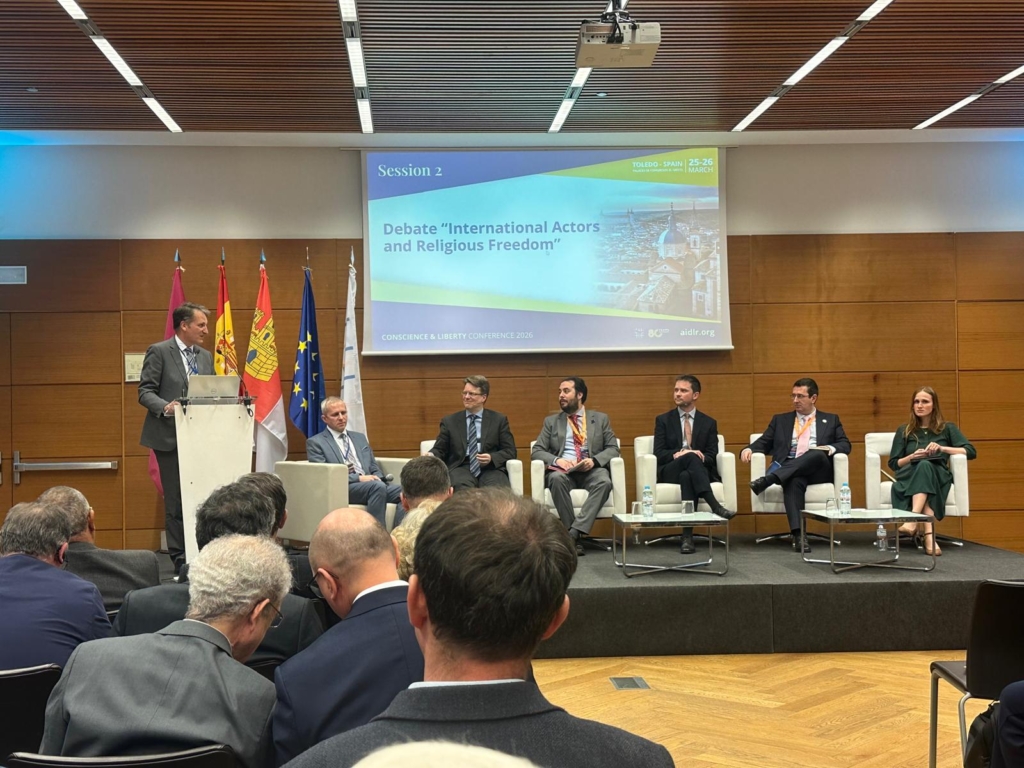
Session 2 – International Actors and Religious Freedom took the form of a structured debate, bringing together a panel of representatives from key international institutions and civil society organizations working on FoRB: Anastasia Hartmann (Open Doors International), Ivan Arjona Pelado (NGO Committee on FoRB at UNOG), Jonathan de Leyser (EPRID, Brussels), Juan José García Carreño (European External Action Service, Brussels), Michael Wiener (OHCHR, UN Geneva), and Maksym Krupsky (PARL SDA, Ukraine). The debate, moderated by Ezequiel Duarte of AIDLR Portugal, examined how multilateral and regional bodies are — or are failing to — respond to contemporary FoRB crises, with particular attention to the growing gap between institutional mandates and enforcement capacity.
Wednesday, 25 March opened with Session 3 – New Challenges to Human Rights, moderated by Rubén Guzmán of AIDLR Spain. Presentations addressed the implications of the decline of the rules-based international order for religious freedom (Harald Mueller, Judge, Hannover); the significance and limitations of the Marrakech Declaration as a signal of Muslim-majority states’ commitment to FoRB (Amal Idrissi, Moulay Ismaïl University, Morocco); and religious freedom within a framework of fragmented global responsibilities (Shabnam Moinipour, Oxford University).
Session 4 – Multilateralism vs Religious Nationalism was anchored by a keynote from Prof. Rosa Mª Martínez de Codes of the Universidad Complutense de Madrid, who traced the dynamics of religious nationalism, multiculturalism, and the political instrumentalisation of religious freedom claims. Speakers further examined current legal trends in state-church relations in Portugal (Fernando Soares Loja, Portuguese Commission for Religious Freedom), and the tensions within the American religious right over the concept of religious freedom in the context of Christian Zionism (Jeremy Gunn, International University of Rabat).
The afternoon of Wednesday brought Session 5 – Impact of Information and Communication Technologies on FoRB, moderated by Raphael Nagler of AIDLR Switzerland. This session confronted directly one of the most urgent emerging challenges to religious liberty. The keynote, “Lights and Shadows of Artificial Intelligence and Religious Freedom,” was delivered by Prof. Jaime Rossel Granados of the University of Extremadura. Subsequent presentations addressed the social problems of AI value alignment and governance as they affect religious communities (Alexis Artaud de la Ferrière, University of London); and AI surveillance and discrimination in the workplace as a new frontier for FoRB violations (Susana Machado, Polytechnic Institute of Porto). The session brought into sharp focus how rapidly evolving technologies are creating new vectors for discrimination, exclusion, and religious persecution — and how governance frameworks are struggling to keep pace.
Session 6 – Voices of Conscience, a plenary debate moderated by Secretary General Paulo Macedo, drew the main programme toward its conclusion. Introduced by Robert Rehak (IRFBA), the debate featured contributions from Ganoune Diop (IRLA and PARL, USA), Ibrahim Salama (British University of Egypt), José Eduardo Vera Jardim (Religious Liberty Commission, Portugal), and Mario Brito, Director of CIRLAP and AIDLR Liaison to the UN in Geneva.
The Closing Session of the main proceedings was attended by the reverend Archbishop of Toledo, Don Francisco Cerro Chávez, and the representative of FEREDE (the Evangelical Federation of Spain), the distinguished Executive Secretary Doña Carolina Bueno. In his remarks to the participants, the Archbishop of Toledo addressed the significance of the event and the indispensability of religious freedom for the dignity of every person. President Barna Magyarosi closed the session with gratitude to all participants, expressing the hope of a future encounter for the next Conference, in 2029.
The Declaration of Toledo 2026
One of the most substantive outcomes of the conference was the adoption of the Declaration of Toledo 2026, an AIDLR statement on rising challenges to freedom of conscience, belief, and religion. The Declaration, which will be published in full on the AIDLR website and disseminated to international institutions, opens with an assessment of the existential challenges facing human rights in the current global context: the weakening of international law, the rise of extreme religious nationalism, aggressive secularism, the politicization of religion, AI-driven discrimination and surveillance, and the compounding effects of armed conflict, social unrest, and climate displacement on religious communities worldwide.
The Declaration sets out Twelve Points of Action, calling upon international organizations, state actors, and civil society to: recognize human dignity as the foundation of all human rights; affirm FoRB as central to the international human rights system; guard freedom of conscience and belief as inviolable and indivisible; enhance commitment to Articles 18 and 19 of the Universal Declaration of Human Rights; promote multilateralism against unilateral erosion of freedoms; prevent and condemn religious discrimination and persecution wherever it occurs; support inter-religious dialogue rooted in genuine freedom of religious choice; reaffirm the separation of state and religion; counter the instrumentalisation of religion for political or electoral purposes; oppose religious exclusivism and nationalism; secure the development and deployment of Artificial Intelligence in ways that respect FoRB values; and promote education, critical thinking, and a culture of mutual respect as foundations of freedom and peace.
The Declaration closes by reaffirming the founding spirit of Jean Nussbaum and his enduring charge: “We don’t stand for interests. We stand for principles.”
Side Talks and Closing: Looking to the Future
Thursday, 26 March is devoted to three “Side Talks” hosted at the Hotel Eurostars Toledo, all oriented toward the future of the field. AIDLR Italy led a session on the future of FoRB studies; Michael Wiener of the UNHRC addresses the future of international organizations in the field of religious freedom; and a final session is dedicated to the strategic future of AIDLR itself. The conference concluded with closing remarks before participants departed.
A Milestone Moment for Religious Liberty
The Conscience & Liberty 2026 Conference will stand as a landmark event in AIDLR’s history — and, more broadly, in the global effort to defend freedom of religion and belief at a moment when that freedom is under unprecedented pressure from multiple directions at once. The combination of high-level political engagement, rigorous academic discussion, and concrete advocacy outputs — above all the Declaration of Toledo — ensures that the conversations held in this historic city will continue to resonate far beyond its walls.
As AIDLR looks ahead to the next chapter of its mission, the words inscribed on the Declaration of Toledo serve as both compass and commitment: to stand, always, not for interests, but for principles.